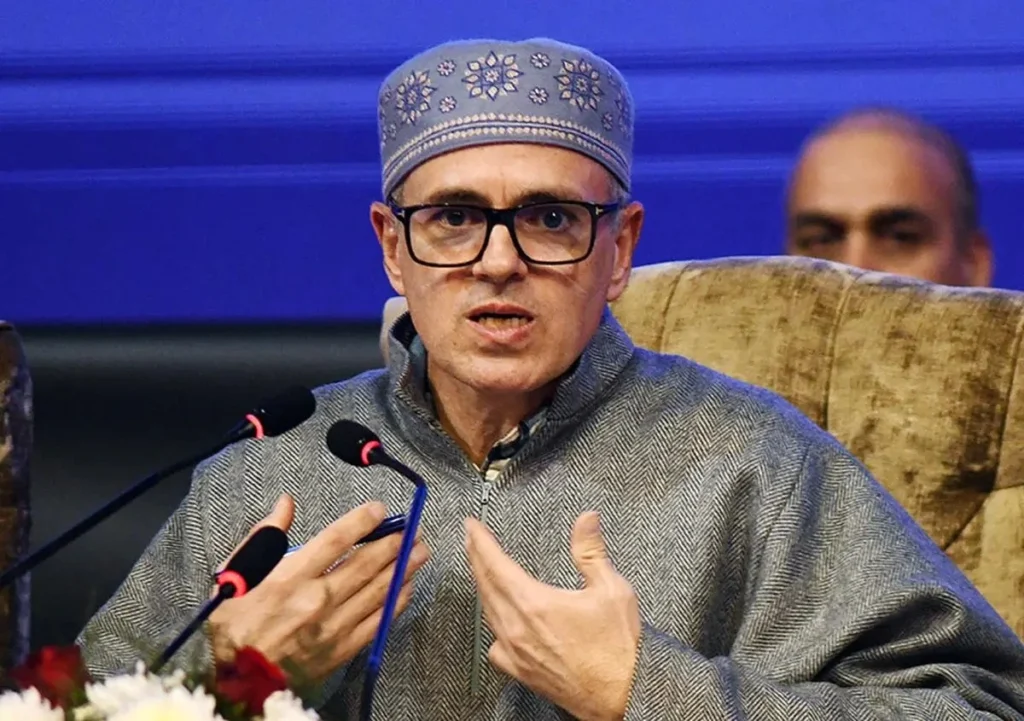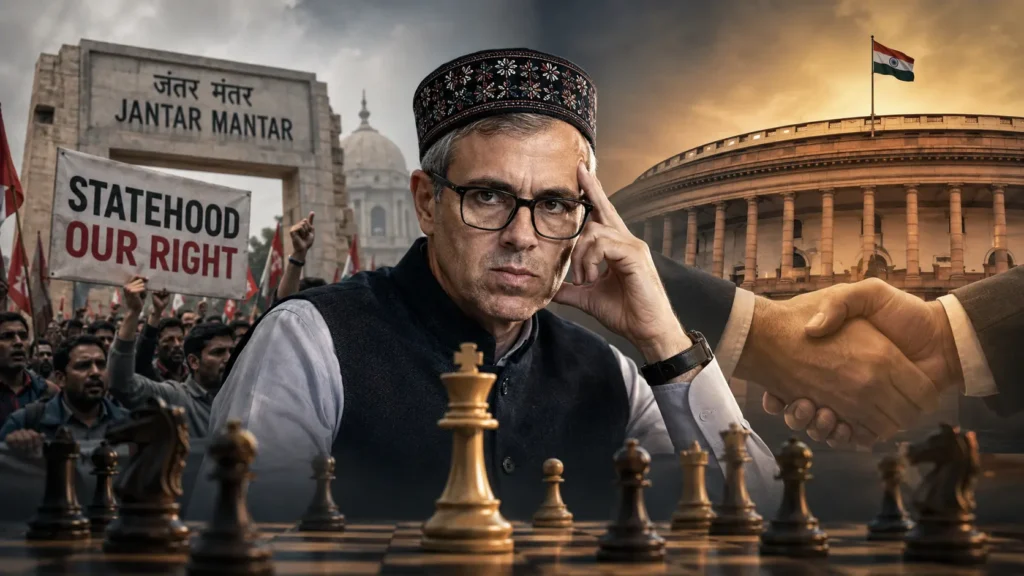
In the high-stakes chess match of Jammu and Kashmir’s politics, Chief Minister Omar Abdullah has long been the grandmaster of nuance. He is a politician who understands the delicate art of the ‘good terms’ protocol – knowing precisely how to navigate the corridors of power in New Delhi while balancing the volatile aspirations of a restless electorate. Yet, even a grandmaster occasionally finds that the board is shifting beneath him, and the pressure of the gallery can force a move that is as much about survival as it is about strategy.
The Anatomy of the ‘Fixed Match’
As the Monsoon Session of Parliament approaches, the National Conference (NC) has announced its intent to stage a dharna at Jantar Mantar. On the surface, it is a clarion call for the restoration of statehood. Beneath the surface, it is an autopsy of a political dilemma that has no easy exit.
- The Pragmatist’s Burden: Abdullah is a hawk at managing relations. He understands that J&K’s survival – fiscal and administrative – is tethered to the Centre’s cooperation. He has consistently played the role of an ambassador of normalcy, prioritizing development and stability. However, he is now caught in a pincer movement. His base is demanding more than just ‘good governance’; they are demanding a symbolic reclamation of dignity.
READ ALSO: The Geopolitical Smokescreen: Why the Rush to Statehood for Jammu & Kashmir Misses the Real Tragedy
- The Pivot: This is where the ‘old hawk’ must change gears. When the groundswell of voter pressure becomes deafening, the diplomat must temporarily yield to the street-level agitator. The Jantar Mantar protest is a calculated gear-shift, designed to appease his cadre and MLAs who fear political irrelevance. It is not an act of rebellion; it is an act of containment.
- The Politricking Masterclass: Abdullah knows that statehood is not won on a pavement in Delhi, but in the quiet, closed-door meetings with the Prime Minister. Yet, by choosing to lead this protest, he masterfully controls the narrative. He is telling the Centre: ‘I am your partner in development, but I am also the voice of my people.’ It is a brilliant, albeit risky, piece of political theater—the classic ‘wrestling match’ where both sides know the choreography, even as the crowd roars for blood.
When the Grandmaster Flickers
Even the most composed leaders find their poise tested by the relentless heat of public expectation. We see the flashes of irritation, the occasional ‘loose tongue’ that betrays the strain of walking a tightrope where every movement is magnified. These are not signs of weakness; they are the cracks in the armor of a man who knows that his every move is being watched by two sets of masters—the central government and the Kashmiri voter.
The protest at Jantar Mantar is a pressure-relief valve. It is an ‘authorized’ display of dissent. By inviting the INDIA bloc, he isn’t just seeking support for statehood; he is signaling to his domestic rivals that he remains the only player capable of orchestrating a national conversation. It is a show of strength designed to mask the reality of his limited constitutional levers.
The Verdict: A Performative Necessity
Is it a farce? Perhaps to the cynic. But in the world of realpolitik, it is a necessity. If Abdullah were to abandon the fight, he would be devoured by the radical fringes of his own political landscape. If he were to truly antagonize the Centre, he would lose the financial lifeblood that keeps his administration afloat.
Thus, he chooses the middle path: the performative protest. It is a spectacle of resistance that satisfies the optics of the street without upsetting the architecture of the state. On the chessboard, he isn’t flickering, he is making the only move that keeps him in the game. The match may be fixed, the outcome may be predetermined, but for a politician of his caliber, the goal is never to win the match instantly, it is to ensure he remains the one holding the pieces when the final move is played.