The Bengal Capture: Decoding BJP’s Saffron Surge as a Geopolitical Deep Dive
The political landscape of West Bengal is undergoing a seismic shift. What was once dismissed by critics as a regional anomaly has now become the central theater of India’s ideological battleground. At The NewsRoom 24, we don’t just report the surface ripples; we dive into the undercurrents. The recent trajectory of the Bharatiya Janata Party (BJP) in Bengal is not merely an electoral statistic; it is a meticulously executed “Geopolitical Capture.”
Here is our exclusive, straight-talking analysis of the strategy, the impact, and the future.
The New Normal: Bengal is No Longer “Different”
For decades, political commentators framed West Bengal as culturally resistant to the core tenets of the BJP. The prevailing wisdom was that Bengal’s unique blend of syncretism and sub-nationalism formed an unbreakable bulwark. That hypothesis has been dismantled.
The BJP’s “Bengal Capture” signifies that the saffron wave has successfully breached the final ideological frontier of Eastern India. This isn’t just about winning seats; it is about rewriting the definition of what is politically permissible in the state.
Beyond the Surface: The Four Pillars of the Capture
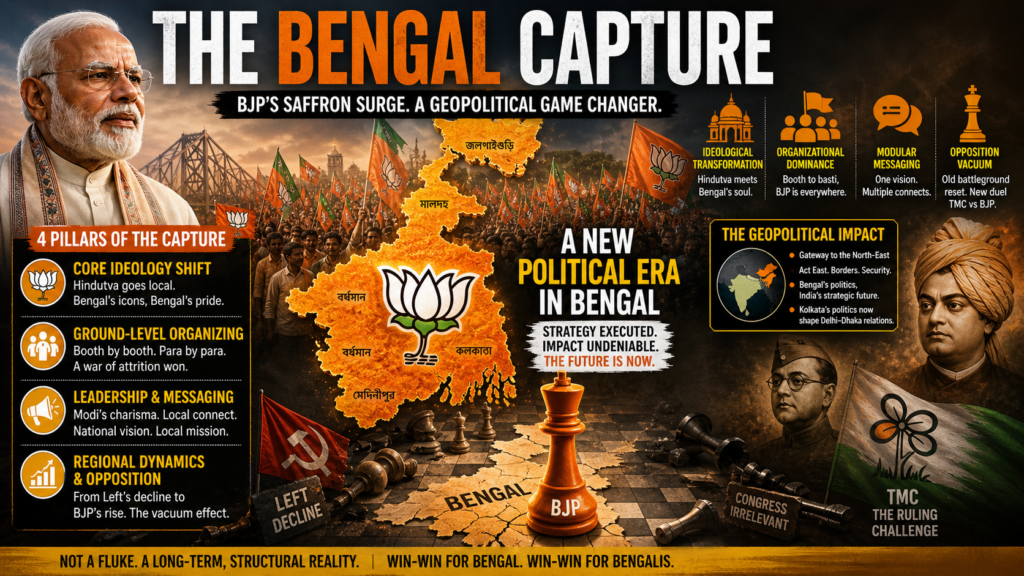
To understand the magnitude of this shift, we must look beyond the standard narratives of polarization and anti-incumbency. The BJP’s rise in Bengal rests on four brilliant, analytical pillars.
- The Core Ideology Shift (The Mainstreaming of Hindutva)
The BJP successfully recognized a latent, often silent, discontent within specific demographics. Instead of parachuting a national narrative, they hybridized Hindutva with Bengali cultural symbols. The effective co-option of icons like Swami Vivekananda and Subhash Chandra Bose, alongside the vigorous celebration of festivals previously less politicized, catalyzed an ideological merger. The result: Hindutva is no longer seen as an external import but as an intrinsic, dormant facet of Bengali identity now awakened.
- Ground-Level Organizing (The War of Attrition)
The growth arrow in our graphic isn’t just symbolic. It represents years of relentless, often violent, bureaucratic and physical attrition at the grassroots. While national media focused on top-tier rallies, the real work was happening in the paras (neighborhoods) and rural blocks.
The BJP didn’t just challenge the dominant party’s structure; they replicated it. By building robust booth-level committees and protecting their cadres against heavy odds, they created a parallel organizational ecosystem. They successfully capitalized on ‘aspirational anxiety’ among the youth, translating disenchantment into a disciplined political force.
- Leadership & Messaging (The Modular Campaign)
The BJP’s messaging in Bengal was a masterpiece of political modularity.
To the National Audience: It was a battle to restore democracy and integrate Bengal into the national mainstream (Vikas).
To the Local Audience: It was a hyper-local fight against alleged corruption, “syndicate raj,” and appeasement politics.
They employed a dual-leadership model, leveraging the charismatic pull of Prime Minister Narendra Modi with strong, aggressive local faces. This allowed them to simultaneously project an image of central authority and regional relatability.
ALSO READ: Festive Fervour at Trikuta Nagar: J&K BJP Celebrates Lohri with Message of Peace and Prosperity
- Regional Dynamics & Opposition (The Vacuum Effect)
An objective analysis must acknowledge the collapse of the traditional opposition, the Left Front and the Congress. The BJP did not only gain votes from the ruling Trinamool Congress (TMC); they expanded into the massive ideological and organizational vacuum left by the decaying ‘red’ cadre base.
Many former Left voters did not shift ideological allegiance overnight; they shifted tactical allegiance to the only force that appeared strong enough to confront the ruling party. The “Bengal Capture” is, in many ways, an unmaking of the old Left-Right binary into a new TMC-BJP duopoly.
Out of the Box: The Geopolitical Impact
Why call it a “Geopolitical Deep Dive”? Because Bengal is not just another state.
Bengal is the gateway to the North-East and a critical hub in India’s ‘Act East’ policy. It shares complex, porous international borders.
A dominant nationalist party firmly entrenched in Bengal radically alters India’s internal security matrix and its cross-border dynamics. The “Bengal Capture” ensures that center-state friction will no longer be limited to financial allocations; it will now encompass fundamental issues of national security, citizenship, and identity. This shift forces a reconfiguration of how New Delhi engages with its eastern neighbors, as the politics of Kolkata now directly impact the policies of Dhaka and beyond.
The Newsroom 24 Verdict
The rise of the BJP in Bengal is not a fluke. It is a long-term, structural reality fueled by brilliant strategic planning and execution. We are witnessing the birth of a new political era in Bengal, one that will be characterized by intense polarization, organizational warfare, and a constant re-negotiation of what it means to be a Bengali in the modern Indian state.
The strategy has been executed. The impact is undeniable. The future is now a high-stakes arena. The development will follow, it’s a win – win for Bengal and Bengalis.