For nearly eight decades, the global conscience has viewed Jammu and Kashmir through a single, exhausted lens: a cartographic tug-of-war between New Delhi and Islamabad. We are told the tragedy is strictly external – a product of cross-border infiltration, geopolitical standoffs, and international legal deadlocks. But this is a convenient geopolitical smokescreen.
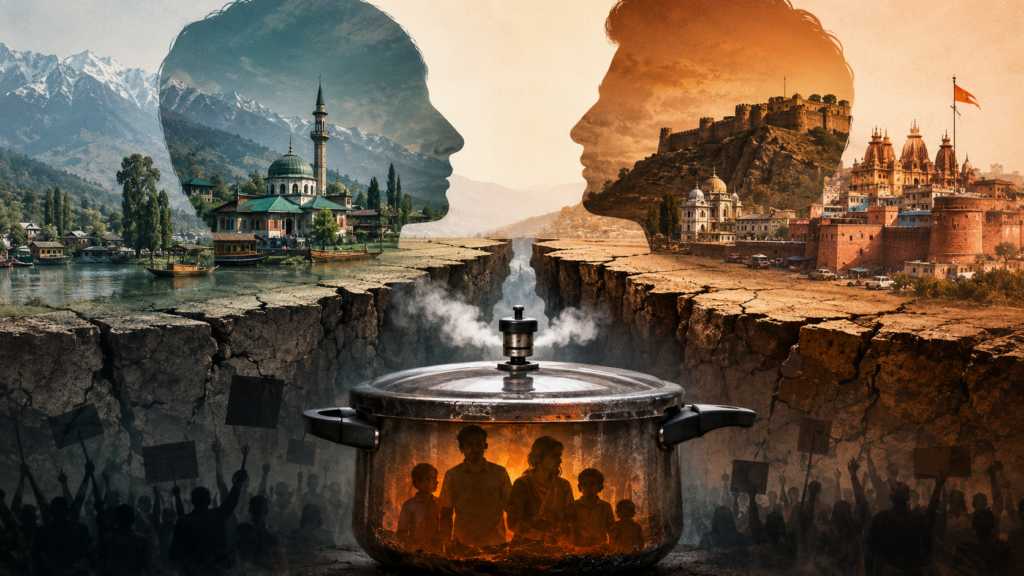
The deepest, most agonizing fracture of Jammu and Kashmir is not the external line drawn in the dirt by warring nations. It is an internal, emotional, and structural chasm that has been quietly tearing the region apart from within. The true tragedy has always been the wide, unaddressed wedge between its two primary sub-regions: the Kashmir Valley and Jammu.
To blindly rush into restoring full provincial statehood without healing this domestic fault line is not a triumph of democracy. It is simply hitting the reset button on a broken machine. It returns absolute power to a structural framework designed for regional conflict, completely ignoring the ordinary people trapped in its gears.
-
THE ARCHITECTS OF CHAOS
The Dynastic Monopoly and the Institutionalized Fire
To dissect the modern anatomy of this conflict, one must strip away the sanitized nomenclature of local governance and confront the political machinery that weaponized it. For decades, two dynastic enterprises – the National Conference (NC) and the People’s Democratic Party (PDP) – operated not as stewards of democratic integration, but as cartels of controlled instability.
Their political survival depended on a deeply cynical, dual-faced strategy. In New Delhi, their leadership wore the sophisticated garb of constitutional stakeholders, demanding massive central subsidies and democratic concessions. But the moment they crossed the Jawahar Tunnel back into the Kashmir Valley, their vocabulary underwent an aggressive transformation. They engineered a hyper-Kashmir-centric majoritarianism, flirting openly with fundamentalist undercurrents to preserve their local hegemony.
This was not a failure of administration; it was a deliberate conspiracy to keep the ground reality burning. By maintaining an ambient layer of grievance and systemic polarization, these dynastic rulers ensured that New Delhi remained perpetually dependent on them as the sole “conduits of peace.” They systematically fed the fires of radicalism because a normalized, fully integrated Jammu and Kashmir would render their dynastic gatekeeping obsolete. They institutionalized a political landscape where regional polarization was the currency, and a burning Valley was the ultimate leverage.
-
THE JAMMU PARADOX
A Tapestry of Harmony and National Alignment
The greatest mischaracterization of this internal divide is the lazy tendency of outside commentators to view it as a simple, binary Hindu-versus-Muslim conflict. To do so completely ignores the profound socio-cultural reality of the Jammu region, which has long deserved its rightful due on the national stage. Jammu is not a monolith of resentment; it is a vibrant, beautiful tapestry of communal harmony and pluralism.
ALSO READ: Diverse yet United, A New Jammu Kashmir: Breaking the divide of an “And” in between
Crucially, the substantial Muslim population residing within the Jammu region- including the native Gujjars, Paharis, Bakerwals, and Dogra Muslims presents a profound paradox to the Srinagar-centric narrative. These distinct communities and habitats do not align with the separatist political undercurrents or linguistic aspirations of the Kashmir Valley. Instead, their lives, dialects, and social fabrics are inextricably bound to a shared lineage and a composite culture rooted deeply in the soil of Jammu.
They are fiercely proud of their regional identity, and they inherently align with the national interest. They do not look across borders or capital cities for validation; they firmly believe they belong to the Jammu region, and their destiny is woven into the secular fabric of the Indian Union. They share the exact same regional grievances of historic “step-motherly” treatment by Srinagar’s rulers as their Hindu neighbors do. By ignoring this, successive dynastic regimes have tried to split Jammu along artificial religious lines, completely failing to understand that Jammu’s regional pride, shared lineage, and unwavering patriotism transcend faith. Jammu must finally get its due recognition, not as a political dependency, but as a bastion of national integration.
-
SILENT SUBJUGATION
The Hegemony of the Valley (1953–2019)
For over six decades after the collapse of the monarchy, Jammu and Kashmir operated under a constitutional and legislative architecture that guaranteed one-sided dominance for the Valley. Despite Jammu making up nearly 46% of the territory and consistently contributing the lion’s share of the state’s tax revenue through tourism, trade, and industry, political control remained firmly anchored in Srinagar.
This was not a minor bias; it was a structural wall built to keep Jammu secondary:
Legislative Gerrymandering
Until the reorganization of 2019, the state assembly seats were mathematically skewed. The Kashmir Valley held a permanent majority with 46 seats, while the vast geography of Jammu was capped at 37. This meant that no political leader from Jammu, regardless of their mandate, could ever become Chief Minister on their own strength. Leadership was, by default, a Kashmiri monopoly, ensuring that state policies always prioritized the anxieties of Srinagar while Jammu’s development was brushed aside as an afterthought.
The Disenfranchised Ghosts
Nothing exposed the cruelty of this framework more than the plight of the West Pakistani Refugees – mostly Hindu and Sikh marginalized communities who fled to Jammu during the horrors of Partition. For seventy years, they were denied basic state citizenship (Permanent Resident Certificates). They could vote for the Prime Minister of India, but they were legally barred from voting in local state elections, owning a single patch of land, or applying for even the lowest-tier government jobs. They lived as institutional ghosts, second-class citizens in a land that loudly preached the gospel of autonomy and human rights.
The “Darbar Move” Circus
Nothing captured the absurdity of this forced marriage more than the Darbar Move. Every six months, at astronomical cost to the taxpayer, the entire state government physically packed up its files, computers, and thousands of bureaucrats to migrate between Srinagar and Jammu. It was a literal traveling circus born out of mutual distrust—a concession designed purely to satisfy the regional egos of two populations that refused to look each other in the eye.
-
FROM THE TURBULENCE TO THE TROOPS
The Iron Fist of Jagmohan and the Military Horizon of Gen. KV Krishna Rao
When this combustible mixture of dynastic complacency and cross-border subversion exploded into an open, Pakistan-sponsored proxy war at the dawn of 1990, the illusion of local administration collapsed overnight. The ground had been completely yielded to the gun. Enter Jagmohan Malhotra.
Appointed for his second gubernatorial stint in January 1990 as militancy reached its absolute, lawless zenith, Governor Jagmohan inherited a completely collapsed state machinery. The local police force was demoralized, intelligence networks had dried up, and armed subversives virtually ruled the streets. Jagmohan understood that before any political reconciliation could occur, the authority of the Indian State had to be re-established with absolute, uncompromising iron resolve.
Operating under intense pressure, his five-month administration deployed an iron glove. Security forces were given a free hand to break the back of urban militancy, dismantle the networks of subversion, and restore basic administrative momentum. While his clinical and uncompromising methods earned him deep criticism from the Valley’s political class, his intervention effectively halted a complete administrative collapse.
Following Jagmohan’s departure, the responsibility of navigating this proxy war fell upon General Kotikalapudi Venkata Krishna Rao, the former Chief of Army Staff, who served as Governor during the peak counter-insurgency years (1989–1990 and 1993–1998). Gen. Krishna Rao approached the conflict not merely as an administrative crisis, but through a definitive military and strategic lens.
He understood that the territory was facing a highly coordinated asymmetric warfare apparatus backed by Islamabad. His tenure was marked by the systematic containment of cross-border terrorism and the clinical execution of grid-level counter-insurgency operations. Gen. Krishna Rao’s strategic grit broke the operational backbone of the foreign mercenary networks, slowly pushing the terrorists out of their strongholds and grinding down the armed insurgency until basic electoral processes could be reintroduced.
-
THE VAJPAYEE DOCTRINE
A Genuine Quest for Humanism
Amidst decades of military gridlocks and political betrayal, Prime Minister Atal Bihari Vajpayee attempted a paradigm shift. Vajpayee realized that an iron glove alone could secure the territory, but it could not heal the fractured psychology of its people. He introduced a historic, highly sophisticated approach that came to be known as the Vajpayee Doctrine, anchored on three foundational pillars:
| Insaniyat (Humanism) | Jamhooriyat (Democracy) | Kashmiriyat (Composite Culture) |
Vajpayee’s approach was a genuine, deeply empathetic effort to look beyond the rigid parameters of traditional security management. He sought to engage the local population directly, bypassing the corrupt dynastic conduits, and extending an olive branch rooted in human dignity. He went to Srinagar and declared that solutions would be found within the framework of humanity (Insaniyat), effectively signaling that the Indian State was large enough, magnanimous enough, and strong enough to embrace its citizens with compassion.
Yet, this genuine statesmanship was consistently sabotaged. The local political class and cross-border handlers mistook Vajpayee’s empathy for structural weakness, weaponizing his goodwill to retrench their old networks of corruption and double-dealing.
-
THE PDP-BJP FIASCO AND THE IRON GLOVE
Confronting the Hypocrisy
The ultimate manifestation of this deep local hypocrisy arrived with the ill-fated, highly contradictory PDP-BJP coalition government in 2015. It was an alliance marketed as an ideological bridge between two disparate regions – the Valley and Jammu. Instead, it became a front-row seat to the complete paralysis of governance.
While the central government attempted to drive development and economic integration, their local partner, the PDP, continuously played a dangerous double-game. The local administration systematically coddled stone-pelters, shielded ecosystem enablers of militancy, and actively obstructed counter-terror operations under the guise of political sensitivity.
ALSO READ: A Plea for Pride & Dignity: The Quest for Statehood in Jammu and Kashmir
By 2018, the national leadership realized that this status quo was an existential trap. The center decided to end the hypocrisy once and for all. The alliance was shattered, Governor’s rule was imposed, and New Delhi pulled off its velvet glove.
On August 5, 2019, the Center executed a monumental constitutional maneuver: the abrogation of Article 370 and the complete bifurcation of the state into direct centrally administered Union Territories. It was a massive, structural declaration that the era of blackmail, dual flags, and dynastic vetoes was permanently over.
-
THE UT ERA AND THE RISK OF PRECIPITOUS PRECEDENCE
The High Cost of a Hurried Transition
Under direct central governance via the Lieutenant Governor (LG) administration, Jammu and Kashmir has witnessed an unprecedented structural turnaround. The results on the ground are tangible, quantifiable, and historic:
- The Demise of the Strike Culture: The orchestrated, calendar-driven hartals (strikes) and violent street stone-pelting that once paralyzed daily life, closed schools, and destroyed the local economy for months on end have been completely eliminated.
- Infrastructure and Tourism Booms: For the first time in three decades, global investments are flowing directly into the territory. Night flights operate out of Srinagar, international summits are hosted seamlessly, and tourist footfalls have shattered all historical records.
- The Empowerment of the Grassroots: The multi-tiered Panchayati Raj system has finally been fully implemented. Development funds are no longer trapped in the bank accounts of a few elite families on Gupkar Road; they flow directly to village councils and local districts.
While a return to statehood remains a constitutional commitment and a fundamental right of the citizens, rushing into it prematurely poses a severe, systemic danger.
To hand back absolute provincial autonomy before these newly established governance networks have deeply set their roots is to risk losing all the hard-won gains of the past seven years. A hurried transition threatens to dismantle the clinical, law-and-order ecosystem built by the UT administration, paving the way for the old political cartels to crawl back into power, resurrect their patronage networks, and bring back the status quo of regional neglect and controlled chaos.
The Roaring Whistle of the Pressure Cooker
The true, unvarnished tragedy of Jammu and Kashmir lies in a bitter, cyclical truth. The political survival of the Valley’s elite has historically depended on speaking against Jammu. Conversely, the political careers of Jammu’s leadership have been built entirely on stoking resentment against Kashmir. It is a perfectly symmetrical theater of grievance, where hatred is currency and division is power.
And in the middle of this grand political circus, a quiet, devastating question goes unasked: What about the people?
No one asks the ordinary citizens what they actually need to survive. No one asks about the failing local schools, the massive youth unemployment, the broken civic infrastructure, or the simple human desire to live a life free from structural anxiety.
The high-pitched whistles of the political pressure cooker blow loudly on television screens, in policy papers, and on international stages, generating noise, posturing, and ideological fury.
Meanwhile, the Aam Aadmi – the ordinary human being on the ground, whether a craftsman in the Kashmir Valley or a resident of the long-neglected Jammu Division—is slowly roasted alive in the boiling anxieties of a system that refuses to heal itself from within.
Until we stop treating Jammu and Kashmir as a geopolitical chess piece, grant Jammu its long-overdue equitable status, and start treating its sub-regions with absolute internal equity, a hurried return to statehood is not an act of liberation. It is merely handing the matches back to the arsonists and waiting for the next explosion.