Jammu, June 1:
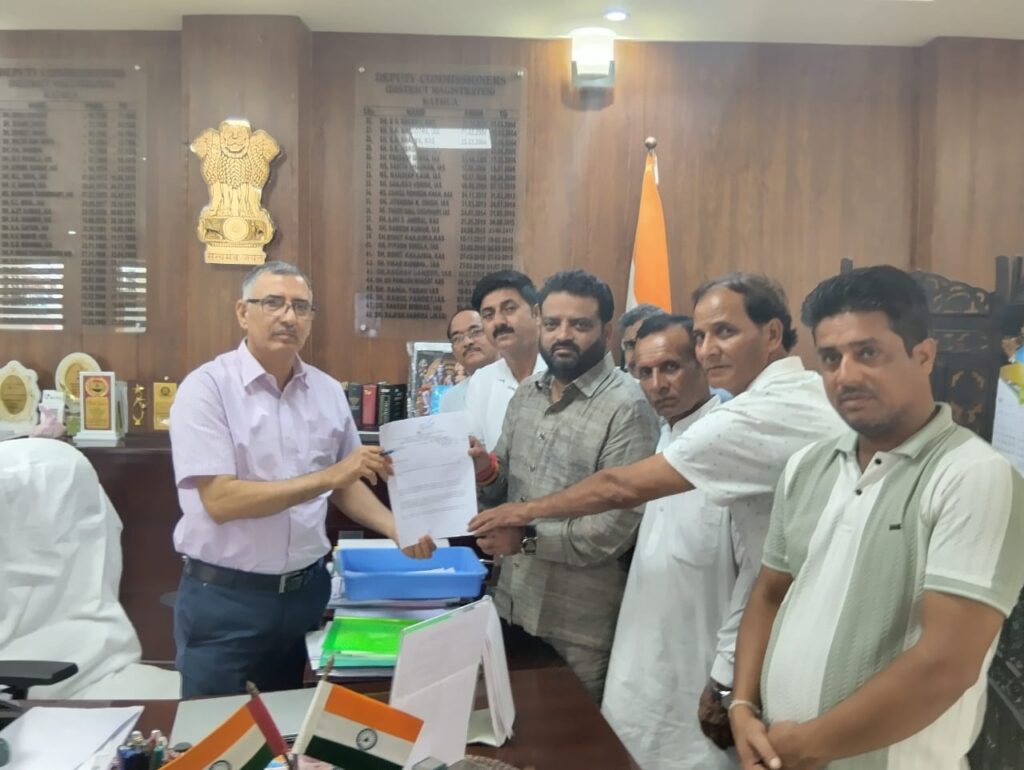
Raising serious concerns over the escalating hardships faced by the local farming community, the Jammu and Kashmir Pradesh Congress Committee (JKPCC) Kissan Congress on Monday submitted a comprehensive memorandum to the Deputy Commissioner (DC) of Kathua. The delegation demanded immediate administrative intervention to ensure the smooth availability of essential agricultural inputs and financial relief ahead of the peak cultivation season.
The memorandum was submitted under the leadership of JKPCC Kissan Congress Chairman Bharat Priye. He was accompanied by a high-level delegation, including District President Tassaduq Hussain, State General Secretary Seva Ram, PCC Secretary Dr. Sandeep Sharma, along with several regional representatives including Krishan Lal Dhegat, Sagar Ram, Darshana Kumari, and others.
Direct Demands: Seeds, Fertilizers, and Subsidies
The Kissan Congress emphasized that the current agricultural window is absolutely critical for the region’s cultivators. The leadership warned that any disruption or delay in the supply chain could severely impact crop productivity and decimate local farm incomes.
The delegation put forward three primary demands to the district administration:
-
Guaranteed Input Supply: Ensure adequate, uninterrupted stocks of fertilizers at all authorized outlets and guarantee the timely distribution of certified, high-yielding seed varieties.
-
Fuel Subsidies: Take up the matter with higher authorities to provide diesel at subsidised rates to small and marginal farmers who rely heavily on diesel-operated machinery and irrigation pumps.
-
Crackdown on Exploitation: Implement strict monitoring and surprise inspections across the district to curb black-marketing, hoarding, and artificial overpricing of essential farming inputs.
Agriculture is the Backbone of Kathua’s Economy
Speaking to media persons outside the DC office, JKPCC Kissan Congress Chairman Bharat Priye underscored the economic vulnerability of the district’s rural pockets.
“Agriculture remains the absolute backbone of our rural economy. Thousands of families in Kathua depend directly on farming for their survival. Right now, our farmers are already grappling with crushing cultivation costs—they simply cannot afford the additional burden of input shortages or black-marketing,” Priye stated.
He further pointed out that the skyrocketing prices of diesel have hit small-scale farmers the hardest, disrupting routine irrigation and transport operations.
Call for Responsive Governance
The memorandum concluded with a strong call for responsive governance and farmer-friendly regional policies. The delegation expressed hope that the Kathua district administration would act swiftly on these demands to protect farming households from exploitation, increase regional crop yields, and ultimately safeguard food security and economic stability in the border district.