Jammu, March 19:
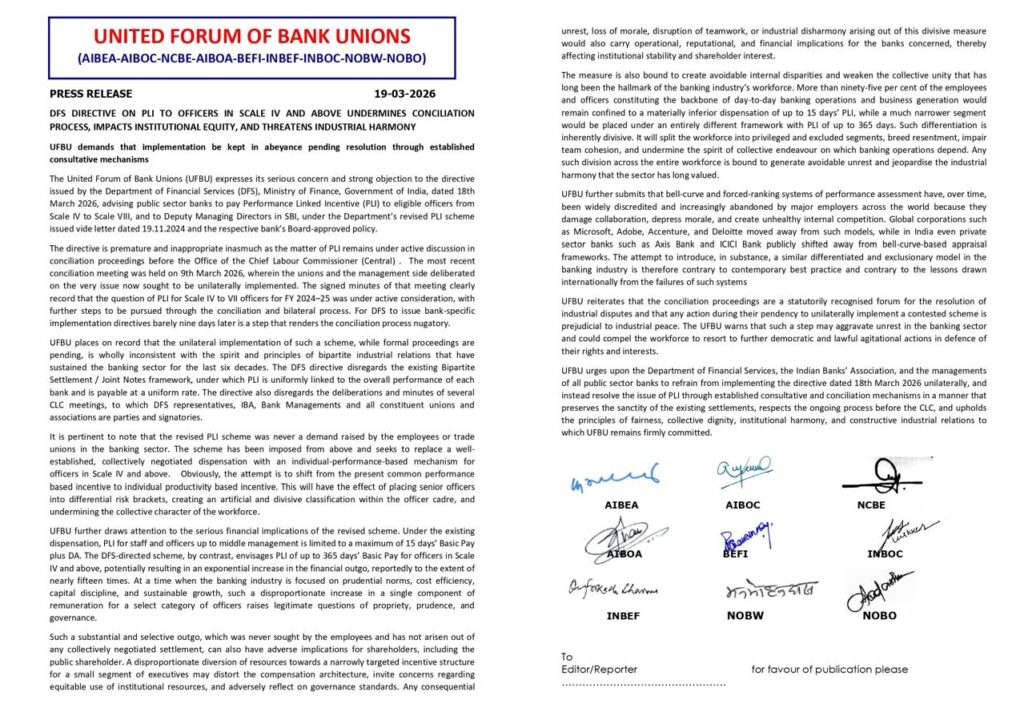
A major confrontation is brewing between the Government and bank unions as the United Forum of Bank Unions (UFBU) issued a scathing response to a new directive from the Department of Financial Services (DFS).
The dispute centers on a revised Performance Linked Incentive (PLI) scheme that unions claim will shatter institutional equity and reward a small “privileged” segment of senior officers while ignoring 95% of the workforce.
The Bone of Contention: 15 Days vs. 365 Days
The UFBU’s primary grievance lies in the massive disparity created by the new DFS directive issued on March 18, 2026. Under the existing bipartite settlement, PLI for the majority of staff is capped at 15 days of pay. However, the new government-mandated scheme offers senior executives (Scale IV and above) an incentive of up to 365 days—a 15-fold increase.
| Category | Current Max Incentive | New DFS Proposed Max |
| Clerical & Junior Officers | 15 Days Basic + DA | 15 Days Basic + DA (No Change) |
| Senior Officers (Scale IV-VIII) | 15 Days Basic + DA | 365 Days Basic Pay |
“A Step Toward Disintegration”
The UFBU has labeled the move “premature and inappropriate,” noting that the issue is currently under active conciliation before the Chief Labour Commissioner (Central). By issuing the directive just nine days after a conciliation meeting, the unions argue the Government is undermining legal statutory processes.
“This scheme seeks to replace a well-established, collectively negotiated dispensation with an individual-performance-based mechanism. It will split the workforce into privileged and excluded segments, breeding resentment and impairing team cohesion.” — UFBU Press Release
Financial and Governance Risks
The unions raised red flags over the “exponential increase” in financial outgo at a time when banks are urged to maintain capital discipline. Key concerns include:
-
Market Distortion: Massive payouts to a small segment may invite scrutiny from public shareholders.
-
Outdated Models: The UFBU pointed out that global giants like Microsoft and Indian private banks like Axis and ICICI have abandoned “Bell-Curve” and “Forced-Ranking” systems, yet the DFS is attempting to reintroduce them in the public sector.
-
Risk Brackets: Placing senior officers into differential risk categories based on individual productivity could compromise the collective stability of the banking sector.
Threat of Agitation
The UFBU has demanded that the implementation be kept in abeyance (suspended) until a resolution is reached through established consultative mechanisms. The forum warned that unilateral action by the Government could compel the nationwide banking workforce to resort to “democratic and lawful agitational actions” to defend their rights.
As of tonight, the Indian Banks’ Association (IBA) and the Ministry of Finance have yet to issue a formal rebuttal to the UFBU’s allegations.