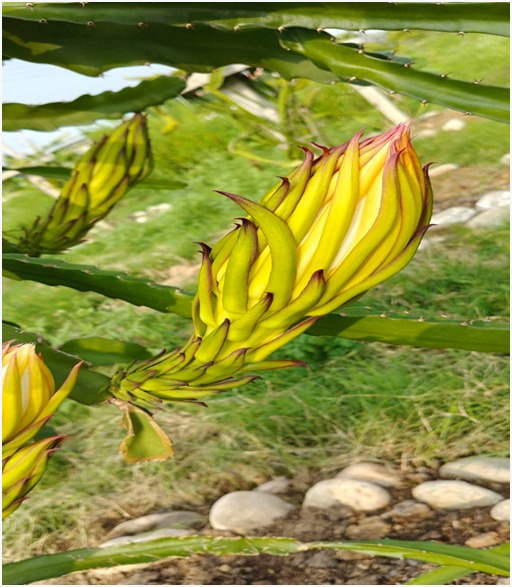
Jammu, March 7:
The landscape of Indian farming is shifting from traditional crops to high-value “superfoods,” and leading the charge is the exotic Kamalam, popularly known as Dragon Fruit (Hylocereus spp.). Once a stranger to Indian soil, this cactus-family perennial has become a favorite for farmers and health enthusiasts alike, stretching from the plains of Gujarat to the valleys of Jammu and Kashmir.
The Rise of the “Queen of the Night”
Originating from Central and South America, particularly Southern Mexico, Kamalam has earned poetic nicknames such as the “Strawberry Pear” and “Queen of the Night.” While Gujarat and Maharashtra remain the primary hubs, its cultivation has now expanded commercially across Karnataka, Tamil Nadu, Punjab, and Uttar Pradesh.
Researchers Shriya Gupta and Harish Kumar from Sher-e-Kashmir University of Agricultural Sciences and Technology (SKUAST), Jammu, highlight that the fruit’s popularity stems from its striking beauty, unique taste, and incredible adaptability to diverse climates.
Why Farmers are Swapping to Kamalam
Dragon fruit is proving to be a “climate-smart” crop. It offers a high return on investment with relatively low maintenance. Key advantages include:
-
Low Water Requirement: As a drought-tolerant cactus, it thrives with minimal irrigation.
-
Resilience: It is naturally resistant to most pests and diseases.
-
Longevity: Once established, a single plant can provide high yields for up to two decades.
-
Multiple Harvests: Farmers can harvest fruits several times within a single year.
“Kamalam is a bridge between sustainability and profitability. It requires less fertilizer and can withstand temperatures ranging from 0 Degree Celsius to 40 Degree Celsius, though it thrives best between 20-35 Degree Celsius,” the SKUAST researchers noted.
A Triple Threat of Varieties
Not all Kamalam fruits are created equal. The market primarily features three distinct types:
| Variety | Appearance | Flavor/Benefit |
| Hylocereus undatus | Pink skin, White pulp | Most popular; mild and sweet. |
| Hylocereus costaricensis | Pink skin, Red/Pink pulp | Loaded with intense antioxidants. |
| Selenicereus megalanthus | Yellow skin, White pulp | Known for a premium sweet-tart flavor. |
The Health Quotient: Why It’s a “Superfood”
Beyond its vibrant scales, Kamalam is a nutritional powerhouse. It is increasingly being used in juices, salads, and desserts for its medicinal properties.
-
Immunity & Digestion: Rich in Vitamin C, flavonoids, and fiber, it boosts the immune system and aids digestion.
-
Chronic Disease Management: Regular consumption is linked to better control of asthma, cough, cholesterol, and high blood pressure.
-
Bone Health: High levels of Phosphorus and Calcium assist in bone strengthening and tissue repair.
-
Ayurvedic Value: In traditional medicine, it is recognized for balancing Kapha and Pitta doshas.
The Path Ahead: Post-Harvest & Sustainability
To ensure this “pink gold” reaches global markets, experts suggest advanced post-harvest management. Storing the fruit at $4\text{–}8^{\circ}C$ or using Chitosan coating can significantly extend its shelf life. This is particularly vital for regions like Jammu and Kashmir, where integrating Kamalam with floriculture could pave the way for a sustainable agricultural revolution.
Kamalam isn’t just a fruit; it’s a symbol of health, beauty, and the future of resilient Indian farming.