Bengaluru, January 30:
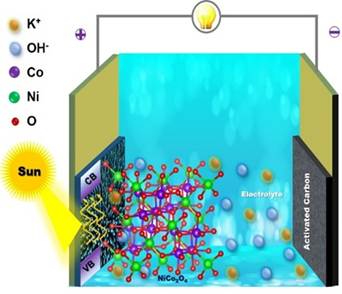
In a major leap for renewable energy, a team of researchers from the Centre for Nano and Soft Matter Sciences (CeNS) has successfully developed a self-charging energy storage device. This “photo-capacitor” can both capture and store sunlight in a single, integrated unit, potentially eliminating the need for separate solar panels and bulky battery systems.
The innovation, led by Dr. Kavita Pandey, marks a significant step toward self-sustaining power for portable, wearable, and off-grid technologies.
The End of the ‘Two-Unit’ System?
Historically, solar power has relied on a hybrid approach:
-
Solar Panels: To capture and convert light into electricity.
-
Batteries/Supercapacitors: To store that energy for later use.
This setup requires complex power management electronics to bridge the gap between harvester and storage. These extra components increase the device’s size, cost, and energy loss—a major hurdle for miniaturized tech. The CeNS team has solved this by merging both functions into one “all-in-one” architecture.
The Secret Sauce: NiCo2O4 Nanowires
The heart of the device lies in nickel-cobalt oxide ($NiCo_2O_4$) nanowires. These wires are only a few nanometers wide but several micrometers long, grown directly on nickel foam using a simple, cost-effective hydrothermal process.
This 3D network is highly porous and conductive, allowing it to act as both a solar harvester (absorbing photons) and a supercapacitor electrode (storing ions).
By the Numbers: High-Performance Specs
The research, published in the journal Sustainable Energy & Fuels, reveals impressive results: Capacitance Boost; 54% increase in storage capacity when exposed to light, Durability; 85% capacity retention after 10,000 charge cycles, Stable Output; Reliable 1.2 Volts of power and Versatility; Operates in low indoor light up to intense “2-sun” heat.
The Science of “Spin”
Why does it work so well? Theoretical studies revealed that substituting nickel into the cobalt oxide framework narrows the “band gap” to approximately 1.67 eV.
More impressively, the material exhibits half-metallic behavior. This means it acts like a semiconductor for one type of electron spin and a metal for the other. This rare dual-property allows for lightning-fast charge transport and high conductivity, perfect for storing light-induced energy.
By integrating capture and storage, we move closer to a world of truly autonomous devices:
-
Wearables: Clothes or watches that charge themselves while you walk outside.
-
Remote Tech: Sensors in forests or mountains that never need a battery replacement.
-
Eco-Friendly Design: Reducing the reliance on traditional lithium-ion batteries and fossil fuels.
“This research represents a paradigm shift,” the team stated. “It provides a comprehensive understanding of how nanostructured materials can be optimized for light-responsive energy storage.”